












Milesight EG71: When to use a multi-protocol IoT Edge gateway?
In a Smart Building or BMS/BAS project, the challenge lies in knowing how to make different equipment, from various technologies, communicate within a reliable and operable architecture.
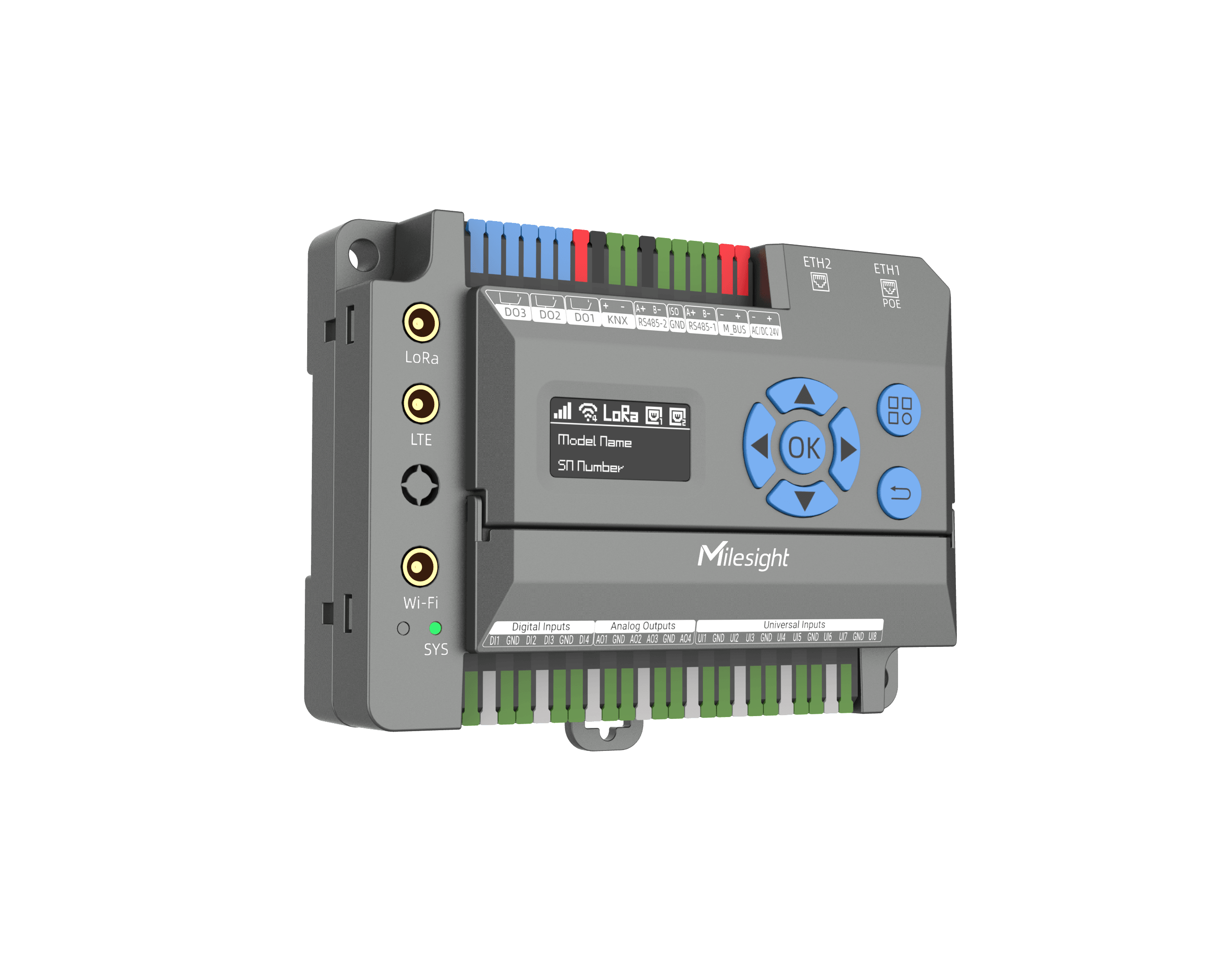
This is precisely the role of a multiprotocol IoT Edge gateway like the Milesight EG71. It centralizes field data, connects multiple types of equipment, and transmits information to a supervision platform, a BMS, or an IoT application.
In this video, we present the extensive capabilities of the EG71 and its relevance for building, IoT, and field integration projects.
A gateway suitable for hybrid environments
In practice, connected buildings rarely rely on a single technology. A single project can combine LoRaWAN sensors, meters, HVAC equipment, PLCs, local inputs/outputs, or existing building systems.
The advantage of the Milesight EG71 is its ability to act as a convergence point for these different types of equipment. It can be integrated into architectures using common protocols such as LoRaWAN, Modbus, BACnet, KNX, MQTT, or HTTP(S).
This versatility helps limit the proliferation of dedicated gateways and simplifies the overall project architecture.
Use case #1: Energy monitoring
The EG71 can be used to centralize data related to a building's energy consumption: metering, sub-metering, temperature, humidity, air quality, or space occupancy.
This data can then be transmitted to a supervision platform to help operators better understand usage, identify deviations, and optimize consumption.
This is a particularly relevant use case for commercial buildings, local authorities, industrial sites, or multi-site buildings.
Use case #2: Renovation or retrofit of existing buildings
In an existing building, it is not always possible to start with a new architecture. It is often necessary to work with existing equipment, different protocols, and wiring constraints.
The EG71 gateway allows connecting heterogeneous equipment without unnecessarily complicating the project. It can bridge wireless sensors, wired equipment, and a supervision platform.
For energy renovation or BMS modernization projects, this approach allows for gradual progress, without replacing the entire existing infrastructure.
Use case #3: Local automation and Edge processing
The EG71 is not limited to data uplink. Its Edge approach also allows for local processing of certain information, closer to the field.
This can be useful for triggering actions, organizing data flows, creating simple logic, or maintaining certain processes even when the connection to a remote platform is not ideal.
For integrators, this capability is interesting as it enables the construction of more autonomous, reactive, and robust architectures.
Use case #4: BMS/BAS integration and IoT platforms
The Milesight EG71 is particularly aimed at integrators who need to connect the field to a BMS, BAS, or IoT platform.
Thanks to its multiprotocol logic, it can act as an interface between building equipment and supervision tools. It thus facilitates data collection, structuring, and transmission.
This is a real advantage for projects where multiple systems must coexist: sensors, meters, actuators, HVAC equipment, PLCs, cloud platforms, or business tools.
Why choose the EG71 for a professional project?
The Milesight EG71 is valuable when a project requires more than a simple LoRaWAN gateway. It makes sense when the environment is hybrid, multiple protocols need to be connected, or local data processing becomes important.
It specifically addresses the following needs:
- centralizing data from multiple pieces of equipment,
- connecting heterogeneous sensors and systems,
- simplifying a Smart Building architecture,
- facilitating integration with a BMS or an IoT platform,
- processing certain data locally,
- reducing the number of intermediate devices,
- preparing an scalable architecture.
Sparwan supports integrators on their EG71 projects
At Sparwan, we support IoT, BMS/BAS integrators, installers, and businesses in choosing their industrial connectivity equipment.
The Milesight EG71 is a particularly suitable solution for Smart Building projects, energy monitoring, multiprotocol integration, and modernization of existing infrastructures.
To go further
Find the complete product sheet and our technical article dedicated to the new configuration interface.