












Power over Ethernet (PoE): Operation, IEEE Standards, and Industrial Applications
Power over Ethernet (PoE) has become an essential standard in industrial networks and smart buildings.
Thanks to this technology, a single Ethernet cable can transmit both network data and electrical power, significantly simplifying the deployment of many devices:
- Wi-Fi access points,
- IoT sensors,
- industrial gateways,
- screens,
- access control systems.
Fewer cables, lower installation costs, and greater flexibility!
In this guide, discover:
- how PoE actually works,
- the differences between PoE, PoE+, PoE++, and passive PoE,
- the IEEE standards to know,
- the benefits for industrial and Smart Building projects,
- how to choose the right PoE switch.
What is Power over Ethernet (PoE)?
Power over Ethernet, or PoE, is a technology that allows the simultaneous transmission of over a single RJ45 network cable:
- Ethernet data,
- electrical power,
Without PoE, each device requires:
- a network cable,
- a dedicated power supply.
With PoE, a single cable is sufficient.
This simplification significantly reduces installation costs, particularly in commercial buildings, factories, or urban infrastructures.
How does PoE work?
A PoE network relies on two types of equipment.
1. The PSE (Power Sourcing Equipment)
It provides the power.
It can be:
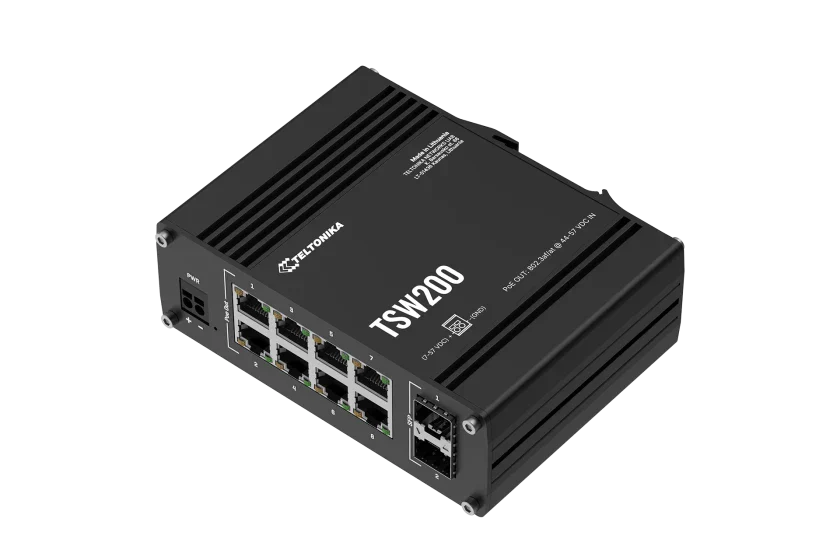
- a PoE switch,
- a PoE injector.
2. The PD (Powered Device)
This is the powered device.
Examples:
- IP camera,
- Wi-Fi access point,
- industrial sensor,
- connected screen,
- IP phone.
The switch automatically detects if the equipment is PoE compatible before sending the electrical voltage (in the case of active PoE). This negotiation ensures a secure power supply for compatible devices.
PoE Switch (PSE)
Power Sourcing Equipment
- ✔ Provides network data
- ✔ Provides electrical power
- ✔ Automatically detects PoE equipment (Active PoE)
on a single cable
Powered Device (PD)
Powered Device
Benefits of PoE
PoE or traditional power?
Power over Ethernet significantly simplifies the deployment of network equipment by combining power and data over a single Ethernet cable. Here are the main differences from traditional power.
| Criterion | Power over Ethernet (PoE) | Traditional Power |
|---|---|---|
| Number of cables | 1 RJ45 cable | 2 cables (network + power) |
| Installation | Fast and simplified | Longer |
| Maintenance | Centralized and simplified | More complex |
| Installation flexibility | Very high | Medium |
| Overall cost | Reduced | Higher |
| Administration | Centralized from the switch | Local management device by device |
Power over Ethernet (PoE) reduces the number of cables, simplifies the installation and maintenance of network equipment, and lowers the overall cost of infrastructure. It is now the preferred solution for Smart Building, Industry 4.0, IP video surveillance, and IoT network projects.
The different PoE standards
IEEE standards ensure interoperability between equipment.
| IEEE Standard | Common Name | Maximum Power | Recommended Applications |
|---|---|---|---|
| IEEE 802.3af | PoE | 15.4 W | IP phones, fixed IP cameras, IoT sensors |
| IEEE 802.3at | PoE+ | 30 W | Wi-Fi access points, PTZ cameras, access control readers |
| IEEE 802.3bt Type 3 | PoE++ | 60 W | Screens, industrial mini-PCs, Wi-Fi 6 access points |
| IEEE 802.3bt Type 4 | PoE++ | 90 W | LED lighting, interactive screens, high-power industrial equipment |
The higher the power, the more demanding equipment can be powered:
- PTZ cameras,
- industrial displays,
- Wi-Fi 6/7 access points,
- LED lighting,
- BMS controllers,
- industrial mini-PCs.
In summary
PoE → small devices.
PoE+ → standard network equipment.
PoE++ → powerful industrial equipment.
Active PoE or passive PoE: what's the difference?
This distinction is essential.
Active PoE
The switch:
- automatically detects the device,
- verifies its compatibility,
- negotiates power,
- protects the equipment.
This is currently the recommended solution.
Passive PoE
The switch directly injects the voltage.
No detection is performed.
The connected equipment must be compatible, otherwise it may be damaged. Some routers and industrial gateways still use this mode of operation depending on the models.
The advantages of PoE
The success of Power over Ethernet is due to several benefits.
Simplified installation
- Only one cable to run.
- Less installation time.
- Less hardware.
Cost reduction
PoE avoids:
- additional electrical outlets,
- individual power supplies,
- electrical work.
Greater flexibility
Equipment can be installed:
- on the ceiling,
- on a pole,
- in a false ceiling,
- outdoors,
- in an industrial cabinet.
Centralized administration
PoE switches allow:
- monitoring power consumption,
- restarting equipment remotely,
- automating energy management.
This approach simplifies the maintenance of industrial networks and Smart Building infrastructures.
Main applications of PoE
Today, PoE is ubiquitous.
Smart Building
- BMS / BAS
- access control
- smart lighting
- IoT sensors
- digital signage
Industry
- production cameras
- RFID readers
- Wi-Fi hotspots
- automated machines
- industrial gateways
Smart City
- video surveillance
- information panels
- charging stations
- public lighting
- smart metering
Retail
- cash registers
- interactive terminals
- cameras
- guest Wi-Fi
Logistics
- scanners
- ANPR cameras
- connected scales
- Wi-Fi access points
How to choose a PoE switch?
Several criteria must be considered.
Number of ports
Example:
- 8 ports,
- 16 ports,
- 24 ports,
- 48 ports.
PoE budget
A switch has a maximum power output.
Example: With a 120 W switch, you can connect:
- 8 devices consuming 15 W
or
- 4 devices of 30 W.
Calculating the PoE budget is an essential step when sizing an infrastructure.
Managed or unmanaged switch?
Managed models allow for:
- VLAN,
- QoS,
- SNMP,
- monitoring,
- port restart,
- energy monitoring.
They are particularly suited for industrial infrastructures and critical networks.
Conditions of use
In industry, prioritize equipment with:
- wide temperature range,
- redundant power supply,
- metal casing,
- DIN rail mounting,
- industrial certifications.
FAQ
What is the maximum PoE range?
The Ethernet standard generally limits a copper link to 100 meters between the switch and the powered device. Beyond this, appropriate extension solutions must be planned.
Are all Ethernet cables PoE compatible?
Cat5e, Cat6, or higher cables are suitable for most installations, provided they are in good condition and properly installed. However, power requirements can influence cable choice depending on the application.
Can a non-PoE device be connected to a PoE switch?
Yes, if the switch uses active PoE compliant with IEEE standards. It automatically detects whether the device accepts PoE before supplying power.
What is the difference between a PoE switch and a PoE injector?
A PoE switch powers multiple devices while providing network switching. A PoE injector simply adds power to an existing Ethernet link for a single device.
Conclusion
Power over Ethernet is now one of the most effective technologies for simplifying network infrastructure deployment. By combining power and data transmission on a single cable, it reduces installation costs, improves flexibility, and facilitates maintenance.
Whether for a Smart Building project, Industry 4.0, video surveillance, professional Wi-Fi, or IoT, choosing the right PoE equipment is crucial for ensuring the reliability and scalability of your network.
At Sparwan, we support integrators, installers, and design offices in choosing PoE switches, industrial routers, and network solutions adapted to demanding environments, with local technical support and recognized expertise in industrial connectivity. This approach fully aligns with Sparwan's positioning as a French expert in industrial connectivity and IoT.
Why choose Sparwan for your PoE infrastructure?
As a French distributor specializing in industrial computing, Sparwan supports integrators, design offices, and installers in choosing their network equipment. Our expertise covers industrial environments, Smart Building, IoT, and critical infrastructures.
We offer you:
- a selection of tested and validated industrial products,
- technical pre-sales advice,
- permanent stock of main references,
- fast delivery throughout France and Europe,
- responsive technical support from experts.
Need an industrial PoE switch?
The choice of a PoE switch depends on the number of devices to be powered, their consumption, the available PoE budget, and the constraints of the installation environment.
Sparwan supports integrators in choosing industrial switches adapted to Smart Building, IoT, and industrial network projects.