










Router, IoT Gateway, or Industrial Modem: What Are the Differences and How Do You Choose?
In an IoT or industrial project, the choice of network equipment is often crucial. Should you install a 4G/5G router, an IoT gateway, or simply an industrial modem? These three product families may seem similar, but they address different needs.
A poor choice can lead to cost overruns, an overly complex architecture, or, conversely, a lack of critical features: network management, security, VPN, industrial interfaces, redundancy, remote supervision…
At Sparwan, we support integrators, manufacturers, and IoT operators in choosing their connectivity solutions. Here is a simple guide to understanding the differences between a modem, router, and IoT gateway, and selecting the right equipment for your application.
The industrial modem: connecting equipment to the mobile network

The modem is the simplest solution. Its primary role is to enable equipment to connect to a communication network, such as 4G, 5G, LTE-M, or NB-IoT.
Specifically, the modem converts your equipment's digital data into signals that can travel over the mobile network, and then performs the reverse operation for received data. Its role remains limited: it does not manage a complete local network, does not route traffic between multiple devices, and generally does not include advanced functions like a firewall or VPN.
When to choose an industrial modem?
A modem is suitable when you have only one piece of equipment to connect and that equipment can manage communication itself.
Examples of applications:
- remote meter reading;
- environmental sensors;
- isolated monitoring equipment;
- simple kiosks or automated systems;
- intermittent data transmission.
For low-power or hard-to-reach applications, LTE-M and NB-IoT technologies are particularly interesting. LTE-M is better suited for mobile objects or those requiring more data exchange, while NB-IoT prioritizes range, signal penetration, and fixed objects installed in complex areas such as basements or underground infrastructures.
In summary
The modem is the right choice if your need is simple: connecting a device to the mobile network, without advanced network management.
The industrial router: sharing, securing, and supervising the connection

The industrial router goes further than the modem. It doesn't just connect a device: it allows you to share an internet connection between multiple devices, manage data flows, and secure communications.
A router can integrate several interfaces: Ethernet, Wi-Fi, 4G, 5G, dual SIM, eSIM, serial ports depending on the models, or even PoE to power certain equipment via the network cable. It also often includes advanced network functions: firewall, VPN, routing, failover, multi-WAN, remote supervision, traffic priority management.
When to choose an industrial router?
A router is recommended when multiple devices need to communicate with each other or access the internet via the same connection.
Examples of applications:
- 4G/5G video surveillance;
- charging stations;
- buses, trains, connected vehicles;
- temporary sites or construction sites;
- connected industrial machines;
- multi-equipment IoT networks;
- backup internet access for a site.
In critical environments, industrial routers also enhance network availability. Some models combine dual SIM, eSIM, multi-WAN, or dual 5G modem to automatically switch from one operator to another in case of signal loss.
The case of PoE
In the field, installing IP cameras, Wi-Fi access points, or network sensors can quickly become complex if each piece of equipment requires both an Ethernet cable and power supply. Routers with PoE/PoE+ ports allow data and power to be transmitted over a single cable, greatly simplifying deployment.
In summary
The industrial router is the right choice if you need to connect multiple devices, secure exchanges, manage the network, and ensure a reliable connection.
The IoT gateway: enabling different worlds to communicate

The IoT gateway acts as an intermediary. It enables communication between equipment, protocols, or networks that do not necessarily speak the same language.
This is often the case in industry: an existing machine might use RS232, RS485, Modbus, digital inputs/outputs, or industrial protocols, without being directly compatible with a cloud platform or a modern IP network.
The IoT gateway then serves to collect, convert, transmit, or route data to a remote system: an IoT platform, supervisory control, cloud, business server, or maintenance tool.
When to choose an IoT gateway?
A gateway is suitable when your project involves existing industrial equipment or specific interfaces.
Examples of applications:
- modernization of an industrial machine;
- PLC data upload;
- supervision of technical installations;
- energy monitoring;
- management of remote equipment;
- data collection via RS232, RS485, or I/O;
- connection of isolated infrastructures to the cloud.
Some gateways directly integrate cellular connectivity (4G, 5G, LTE-M, or NB-IoT). This allows industrial equipment to be connected without adding a router or an intermediate PC.
In summary
The IoT gateway is the right choice if you need to connect industrial equipment, a protocol, or a field interface to an IP network, a cloud platform, or a supervisory system.
Router, modem, or IoT gateway: comparative table
|
Equipment |
Main function |
Choose if… |
Usage examples |
|
Industrial modem |
Connect equipment to the mobile network |
Only one device needs network access |
Sensor, meter, isolated equipment |
|
Industrial router |
Share and secure a network connection |
Multiple devices need to communicate or access the Internet |
Cameras, machines, vehicles, remote sites |
|
IoT Gateway |
Enable different protocols or interfaces to communicate |
You need to connect industrial equipment to a modern network |
PLCs, RS232/RS485, Modbus, cloud supervision |
How to choose the right solution for your IoT project?
To choose between a modem, router, and IoT gateway, you should start with the field requirement, not just the technology.
Ask yourself the right questions.
How many devices need to be connected?
A single device can sometimes be satisfied with a modem. Multiple devices generally require a router.
Do communications need to be secured?
If you need VPN, firewall, network filtering, or secure remote access, an industrial router is often essential.
Does the equipment use an industrial interface?
RS232, RS485, Modbus, digital inputs/outputs: in this case, an IoT gateway is probably more suitable.
Is the site difficult to access?
For installations in basements, rural areas, or on isolated infrastructure, the choice of radio technology—4G, 5G, LTE-M, NB-IoT—becomes crucial.
Must the service remain available at all times?
For critical applications, prioritize routers with dual SIM, eSIM, multi-WAN, failover, or dual cellular connectivity.
Conclusion: the right equipment depends on your architecture
An industrial modem simply connects equipment to the network.
An industrial router shares, secures, and administers connectivity.
An IoT gateway connects industrial equipment, protocols, or interfaces to a modern network.
In many IoT projects, these solutions can even be complementary. A meter, a camera, a PLC, or an industrial machine do not have the same constraints in terms of bandwidth, power supply, security, or integration.
At Sparwan, we distribute and select industrial connectivity solutions suitable for IoT projects, 4G/5G networks, LoRaWAN, and rugged environments. Our role: to help you choose the right equipment, avoid cost overruns, and secure your deployments from the design stage.
Do you have an IoT, industrial, or 4G/5G project? Contact our team to identify the most suitable connectivity solution for your use.
FAQ: modem, router, and IoT gateway, how to choose the right equipment for your application?
Do I need a router or a gateway for my IoT project?
It depends on your devices and how they communicate. If your devices already use standard IP communication and simply need shared internet access on a network, a router is likely sufficient. However, if your devices use industrial protocols such as RS232, RS485, or Modbus, a gateway is necessary to convert this data before integrating it into an IP network.
Can a modem be used instead of a router in an IoT deployment?
A modem is sufficient when only one device needs internet access and no traffic management or communication between devices is required. However, most IoT deployments involve multiple devices that need to share a connection and communicate with each other, making a router essential. In some cases, both are used in conjunction: the modem manages the internet connection, and the router manages the local network.
Which connectivity technology should I use for high-bandwidth IoT applications?
High-bandwidth applications, such as video surveillance or real-time data processing, require technologies capable of handling large volumes of data with minimal delay. 5G is currently the most powerful cellular option for these scenarios, offering the throughput and low latency necessary for reliable operation.
How to choose the right device for my IoT project?
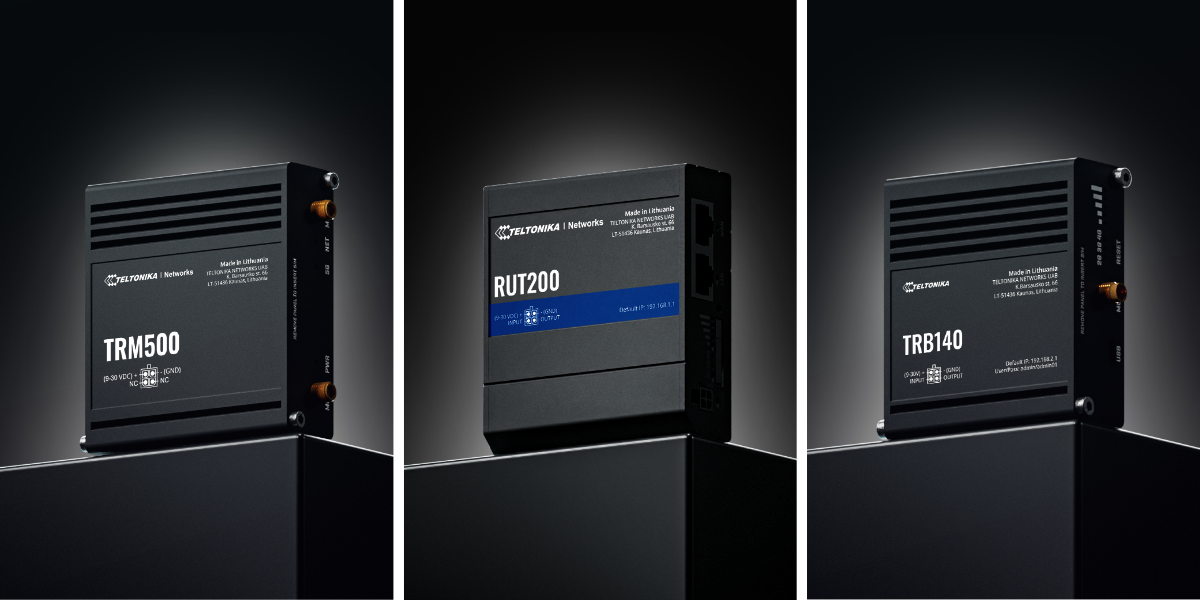
The choice of the appropriate device depends on three main factors: the amount of data your application needs to transmit, the location of your devices, and the communication protocols they use. If your devices only require a cellular internet connection, a modem like the TRM250 or TRM500 may suffice. If you need to share this connection among several devices or manage network traffic, a router from the Teltonika range is the ideal solution. If your equipment uses industrial protocols incompatible with standard IP networks, a Teltonika gateway will ensure this interoperability.