







LoRaWAN, all about a technology that is revolutionizing IoT
LoRaWAN is now one of the leading IoT technologies. Thanks to its long range, low energy consumption, and enhanced security, it is being adopted in various fields: Smart Building, Smart City, Smart Office, and Smart Agriculture.
Adopted by more and more companies and local authorities, LoRaWAN is revolutionizing IoT connectivity by enabling the rapid deployment of reliable, economical, and scalable sensors.
What is LoRaWAN technology?
LoRaWAN stands for Long Range Wide Area Network. It's a wireless communication protocol that connects internet-connected objects (IoT) to data networks. It uses LoRa (Long Range) technology, which transmits data over long distances with a low data rate. Your smart devices can thus communicate seamlessly wherever they are.

LoRaWAN is designed for use in urban and rural environments. It can be used for various applications, such as monitoring, resource management, connected health, security, etc. It supports a large number of connected devices, such as sensors, actuators, and network terminals.
LoRaWAN can be used in multiple fields: Smart City, Smart Building, Smart Office, and Smart Agriculture.
How does LoRaWAN work?
LoRaWAN has 4 main components:
-
end nodes,
-
gateways,
-
the network server,
-
the application server.

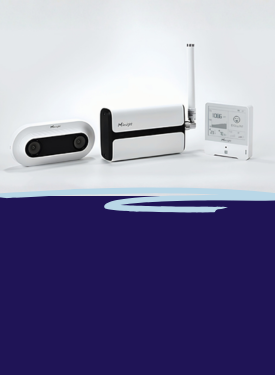
End nodes, such as sensors, collect data and transmit it to gateways using LoRaWAN. Gateways act as intermediaries between end nodes and the network server.
The network server manages communication, authentication, security, and data routing. It receives data from gateways and sends it to the application server based on predefined rules.
The application server then processes the data, allowing for its integration, analysis, and visualization with other systems.
Why choose LoRaWAN and what are its advantages?
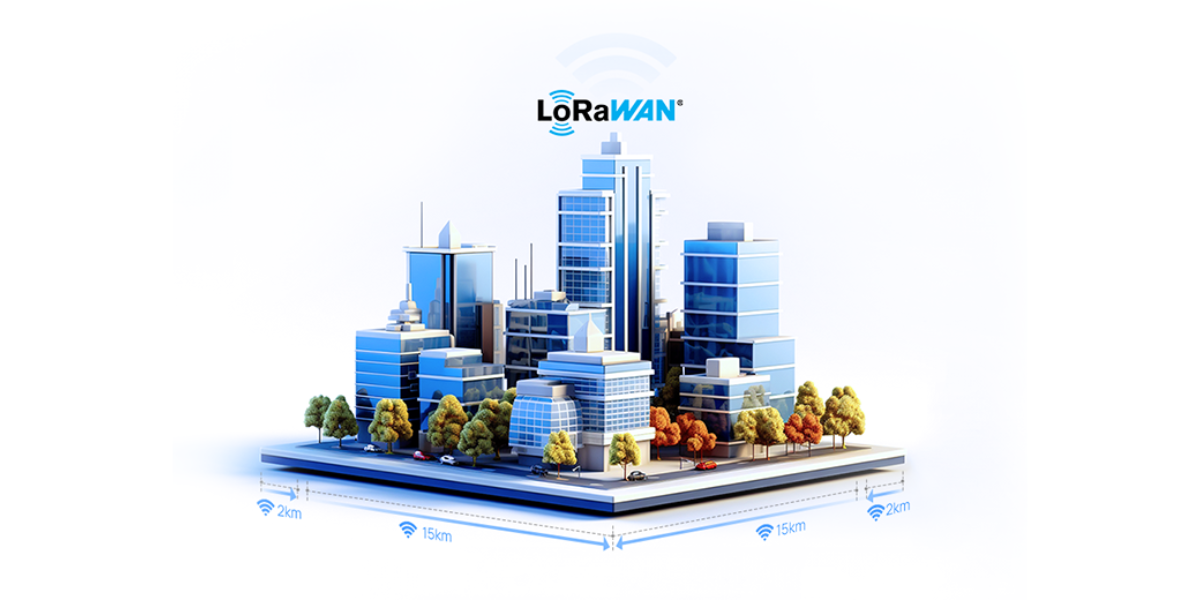
- Long range: one of the main advantages of LoRaWAN lies in its exceptional long-range capability. The distance between nodes and the gateway can vary depending on factors such as the environment or precision. LoRaWAN can therefore cover vast distances: up to 2 km in urban areas and 15 km in rural areas.
- Low power consumption : another remarkable characteristic is its low power consumption. LoRaWAN operational IoT devices can run on small batteries for years, reducing maintenance frequency and extending hardware lifespan.
- Compatibility with a large number of connected devices : LoRaWAN networks are highly scalable, allowing up to 2,000 nodes to connect from a single gateway and managing thousands of devices in anticipation of future growth.
- Ease of use : LoRaWAN uses a simple network architecture, making it easy to deploy and manage networks.
- Affordable cost : LoRaWAN is an affordable communication protocol, enabling businesses to deploy IoT networks at low cost.
- Security : LoRaWAN uses security protocols to protect data and networks from malicious attacks. It ensures data confidentiality, integrity, and authenticity.

A wide range of applications
The LoRaWAN communication protocol adapts to a wide range of applications.
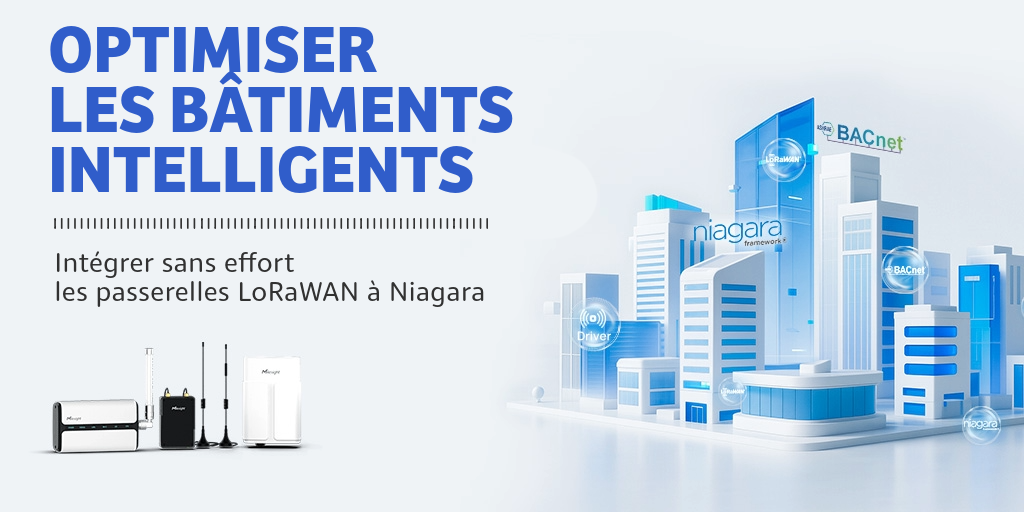
Smart Building : smart buildings use IoT (Internet of Things) technologies to improve energy performance, security, and user comfort. LoRaWAN is ideal for this type of structure because it allows low-power sensors and actuators to be connected to long-range networks, enabling remote monitoring and control of environmental parameters.

LoRaWAN sensors can be used to measure parameters such as temperature, humidity, brightness, air quality, and energy consumption, and LoRaWAN actuators can be used to control heating, air conditioning, and lighting systems. The data collected by the sensors can be used to optimize the energy performance of buildings, which reduces operating costs and improves user comfort.
Smart City : in smart cities, LoRaWAN is used for parking, waste management, smart and environmental meters. It enables efficient monitoring and resource optimization, thus improving the quality of life for citizens.

Smart Agriculture : in agriculture, LoRaWAN enables remote monitoring of soil conditions and optimization of irrigation, leading to better crop yields. It promotes sustainable and efficient agriculture.

3-point FAQ
-
What is LoRaWAN?
LoRaWAN (Long Range Wide Area Network) is a long-range, low-power, and secure wireless IoT communication protocol used to connect sensors and actuators. -
What are the advantages of LoRaWAN?
LoRaWAN offers long range (up to 15 km), low power consumption, high scalability, reduced cost, and enhanced security for IoT data. -
In what fields is LoRaWAN used?
LoRaWAN is applied to Smart Building, Smart City, Smart Office, Smart Agriculture, as well as energy, water, waste management, and connected health.
LoRaWAN is a game-changer in IoT connectivity. Its long-range capabilities, low power consumption, high scalability, and security make it a powerful technology for various applications. From smart cities to agriculture, LoRaWAN paves the way for a connected future.
Discover our LoRaWAN solutions
Our teams are available to advise you on your future projects and support you via our technical support. Contact us!