









WT101 vs WT102: Milesight LoRaWAN Thermostat Comparison
In Smart Building projects, heating control is a key lever for reducing energy consumption. LoRaWAN thermostats like Milesight's WT101 and WT102 allow integrators to deploy scalable, interoperable, and remotely controllable solutions. But which one should you choose for your project?
LoRaWAN Thermostat: what are the challenges for integrators?
Before comparing, it's useful to recall the main benefits of LoRaWAN thermostats. These solutions help reduce energy costs, with savings of up to 30%, while facilitating mass deployment without wiring. They also offer centralized multi-site supervision and integrate easily into GTB / BMS environments.
For integrators, the choice of thermostat is not just a matter of features. It has a direct impact on the TCO (Total Cost of Ownership), on the level of field maintenance required, as well as on the overall operational performance of the project.
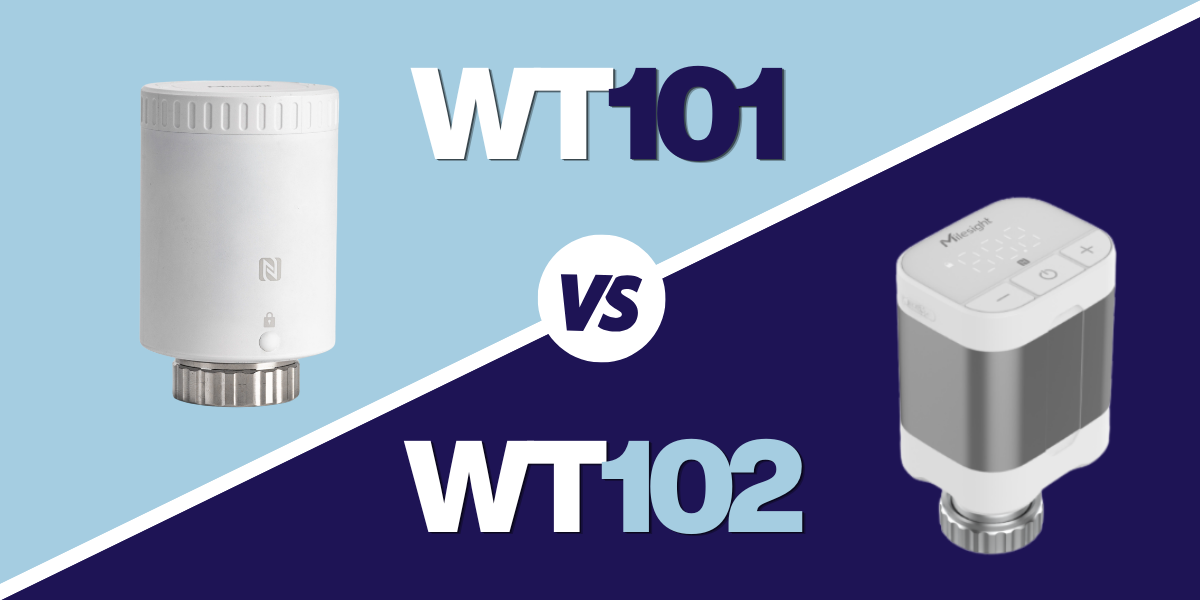
WT101 vs WT102 Comparison
| Criterion | WT101 | WT102 |
| Technology | LoRaWAN Class A | LoRaWAN Class B |
| Power Supply | Batteries (AA) | Battery-free (energy harvesting) |
| Maintenance | Battery replacement | No maintenance |
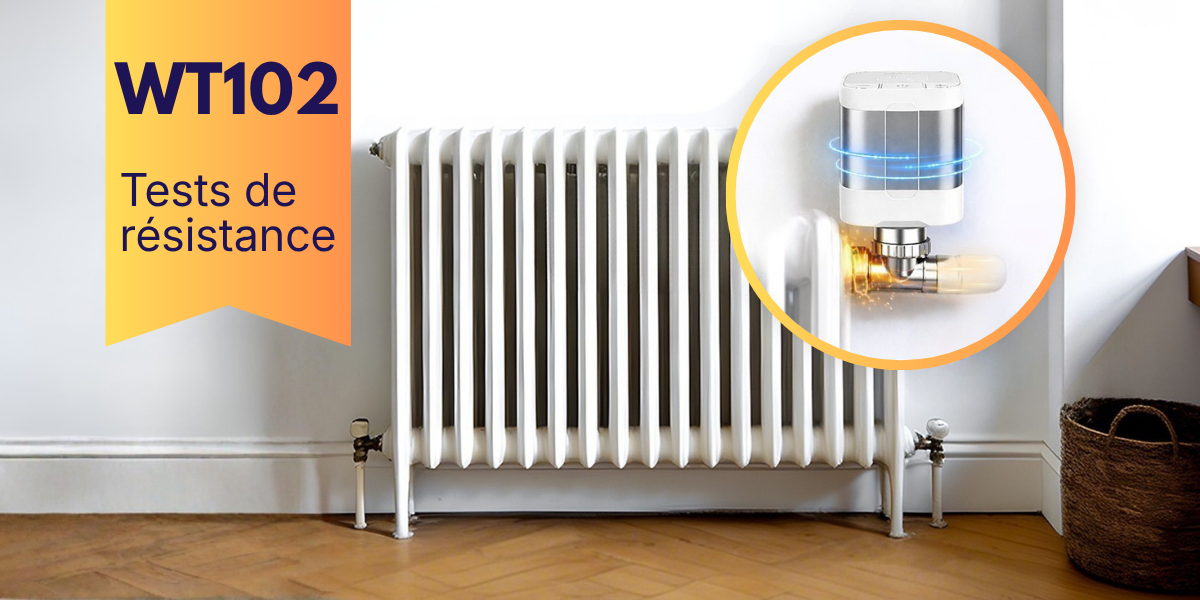
| Robustness | Standard | Metal casing |
| Responsiveness | Standard | Fast response time (~4s) |
| Deployment | Mass / economical | Premium / long term |

WT101: Ideal LoRaWAN Thermostat for Large-Scale Deployment
The WT101 is currently a benchmark for IoT heating projects.
Advantages
- Long battery life (up to 10 years).
- Quick installation (NFC + simple mounting).
- Compatible with most radiators.
- Optimized cost for large projects.
Use Cases
- Collective housing.
- Hospitality.
- Offices.
- Energy retrofit.
Limitations
- Battery-related maintenance.
- Higher latency (Class A).
WT102: Battery-Free LoRaWAN Thermostat for Advanced Smart Buildings
The WT102 represents a major evolution in connected thermal management.
Advantages
- Zero maintenance (no battery).
- LoRaWAN Class B communication (near real-time).
- Robust design (anti-vandalism).
- Total Cost of Ownership (TCO) optimization.
Use Cases
- Public buildings (schools, hospitals).
- Complex Smart Buildings.
- Social housing.
- Hard-to-access sites.
Limitations
- Higher initial cost.
- Oversized for small projects.
IoT & BMS Integration: WT101 vs WT102
Both the WT101 and WT102 models offer standard LoRaWAN integration, making them compatible with multi-brand gateways. They are also designed to work with various IoT platforms and feature APIs that facilitate their integration into GTB / BMS environments. Finally, they allow multi-site management, making them suitable for larger-scale deployments.
The main difference between the two models lies in their operating logic. The WT101 is oriented towards a logic of periodic reporting and control, while the WT102 is designed for near real-time control.
ROI: WT101 or WT102?
The WT101 stands out for its short-term return on investment. Thanks to a lower initial investment, it is a particularly suitable solution for mass deployments. However, its operation involves on-site maintenance, notably due to battery management.
The WT102, on the other hand, is more aligned with a long-term return on investment logic. Its main advantage is the absence of on-site maintenance, which allows for reduced operating costs over time. This makes it a particularly relevant choice for multi-site contracts.
Which thermostat to choose for your project?
Choose WT101 if:
- project with budget constraints,
- need for rapid deployment,
- standard environment,
- acceptable maintenance.

Choose WT102 if:
- zero maintenance objective,
- public or critical buildings,
- TCO optimization is a priority,
- need for high responsiveness.

In conclusion, the WT101 stands out as the best choice for massive and economical projects, while the WT102 is a premium solution perfectly suited for sustainable Smart Buildings. In summary, prioritize the WT101 for volume and cost considerations, and the WT102 for performance and a long-term vision.
Need help choosing between WT101 and WT102?
Let's talk about your project: our experts will help you identify the most cost-effective solution based on your field constraints: contact us!